Sunday, October 11, 2009

Yisrael - My Struggle with G-d

I have shared openly with many people that I struggle with G-d (the meaning of the word Yisrael). Causes range from "the Holocaust" to the "see it to believe it" and looking at a rainbow or a baby ain't enough for me because of science. Some days, I am jealous of people who have a strong faith in G-d (or relationship with). There are times when I hypothesize that if the word "G-d" wasn't about a Being but a definition of the collection of history, tradition, liturgy, values, holidays, celebrations and community that I believe so much in, then I would accept the idea.

I get asked about "why pray?" ... why keep a level of kashrut. The answers: why pray - community and just in case .... and as for kashrut .... because Bubbie did. It's certainly not because of commandments, it's because each Jewish dietary decision I make reminds me in that moment of my Judaism. Having said that, I can't explain my powerful believe in b'shert (in meant-to-be situations and in soulmates.

There is this joke that says that even atheists believe in G-d in a foxhole. I am sitting in the proverbial foxhole, and I am not sure I agree.

On Friday morning, I got the call no one ever wants to get. The one where you are told a parent has had a catastrophic cardiac episode and the future is unclear. You especially don't want that call when you live 1000 miles from your family. So this is my foxhole. And I haven't done what everyone expects me to do - start negotiating with G-d.

I have talked to my Dad ... over the long distance and sitting at his bedside. I have "spoken" to loved ones who have passed on and had conversations with them begging them to send him back from the light. I have recited pieces of liturgy around healing - maybe more for my comfort and again in that "just in case." I have asked those around me who are in a relationship with G-d (in any religion) to add him to their thoughts and prayers. But I haven't directly reached out to G-d while sitting in my foxhole. It seems hypocritical.

Things are grim in my foxhole. I am sitting at his bedside now. He has yet to regain consciousness and so far he isn't responding to basic neurologic stimuli. The doctors have told us that there isn't any conclusive evidence yet that he won't at some point in the near future ... but they can't guarantee he will either.

Mi Shebeirach

Mi shebeirach avoteinu
M'kor habracha l'imoteinu

May the source of strength who blessed the ones before us,
Help us find the courage to make our lives a blessing
And let us say: Amen.

Mi shebeirach imoteinu
M'kor habracha l'avoteinu

Bless those in need of healing with refuah sh'leimah
The renewal of body, the renewal of spirit
And let us say: Amen.

Lyrics by Debbie Friedman and Drorah Setel

Saturday, September 26, 2009

Ramping Up

The days before Rosh HaShanah ... everyone wishing me a Shanah Tovah. Asking, "So, are you ready for the holiday?"

Ummm. No. Not really. Cooking for dinner-yes, ready for my guests. For the holidays, no. Never. High Holy Days, kinda not my thing. Sukkot-enjoy Sukkot. But ready for Rosh HaShanah and Yom Kippur. Nope.

These are remnants of the canned answers I gave to the question, "So are you ready for the holiday?" Internally, I kept thinking/questioning. Stream of Consciousness: work - lot's to do on that checklist, cleaning-a little every day, planning dinner menu, starting soup, shopping for cooking ingredients. I'm lonely right now - not entrenched in a synagogue community. Wish I were in Dallas for the holidays. Should I go to Dallas? Maybe New York. No - travel too much, stay here-here is lonely. Have to go get tickets. Tickets for the holidays, sucks. Membership dues for shuls - sucks even more. Have to get tickets. Need to go to synagogue. Not sure why I need to go, not a huge fan anyway. Consider riding the couch for the weekend. No, get tickets. It's the right thing. Don't forget to pay mid-month bills.

It makes no sense to be going about your daily life, worrying about daily stresses, and wake up one day "ready for the holiday." And then, for the first time ever, it hit me. That's the point of Elul. Elul is the Jewish month preceding Tishrei (the Jewish month that starts with Rosh HaShanah). Elul ... 29 days preceding the Holy Days. The point of Elul - 29 days of ramping up.

As a Jewish educator, I know that there are rituals that some people perform during Elul.
  • hearing the Shofar blow each day - the blasts awakening us, calling us
  • reciting Psalm 27
  • reciting Selichot
  • and less traditionally: reading special books and poems, journaling, meditating, etc
But I have never participated in them (other than attending an occasional Selichot program the Saturday before RH). [Note: This year, I went to a local congregation that was performing the staged reading/play "Standing at Sinai" which was written by my dear friend, Jeff Bernhardt. But I bailed before services.]

So - lesson learned. I need Elul. And while going to shul every day for Shacharit (morning prayers) to hear the Shofar blow might not be "my thing," I need to figure out what my thing is. Maybe finding someone to blow the Shofar for me on my own time schedule (even over the phone or Skype), maybe some guided journaling, and maybe spending a few minutes on each day of Elul calling one person I haven't talked to in a while (idea taken from a friend of mine!).
Whatever it is, one thing is for sure, I need to ramp-up. I can't just drop into the holidays and expect to feel something. I need Elul.


Wishing all of my friends and family a Happy and Healthy New Year and a Yom Kippur of meaning.

Sunday, September 13, 2009

Inglorious

For weeks, I read friends' Facebook status updates touting the movie Inglorious Basterds, so I decided to take myself to see it.

When I posted that I was headed off to the movies to catch this flick, many people commented on my status - again saying what a great movie it is, some even saying it was the best movie they had seen.

I have to say, I completely disagree. First of all, I spent a good chunk of the movie hidden behind my own hands, eyes tightly shut, and in several cases, even closed my ears. The shear gratuitous violence gave the movie it's first negative in my opinion. (Apparently, this is a trademark of Tarantino, but I haven't seen the majority of his movies so I had no clue this was the case.) The second, and more important perhaps, reason I didn't like this movie is inextricably linked to my opposition to the death penalty.

There are many reasons I am opposed to the death penalty:
  • it's irreversible and sometimes we make mistakes in who we identify as the guilty party
  • in the American court system it can be more expensive than life imprisonment which is a bad way to spend taxpayer $$
  • for the guilty - it's an easy way out - not having to live with the crime
  • for the family of the guilty (who are often completely innocent in their loved ones choices) it is yet another emotional blow
  • it's not our job to "play G-d"
  • Judaism strongly advises against using it
Whenever I get into debate about this issue, people always throw out Hitler - stating "If you had the chance to be the one to push the electric chair button on Hitler, you would do it." Truth is, I wouldn't. No one believes me, but I am THAT opposed. I don't have a problem locking him in a 5x5 concrete isolation cell with pictures of the people he tortured wallpapering the cell and no human contact and no sunshine ... but I do have a problem ending someone - anyone's - life.

Jewishly, the rabbis who wrote the Talmud created huge barriers to actually using the death penalty that in practical terms made it almost impossible to punish anyone by death.
  • The defendant may not be put to death unless two (or in some cases three) eyewitnesses testify against him or her
  • Each witness must be so certain of his testimony that he personally would be willing to carry out the execution
  • (Mishnah Makkot 1:10): "A Sanhedrin that puts a man to death once in seven years is called destructive. Rabbi Eliezer ben Azariah says: even once in seventy years. Rabbi Akiba and Rabbi Tarfon say: had we been in the Sanhedrin none would ever have been put to death...."
Personally, I have a relationship to the question of the death penalty. Remember the episode of West Wing, where the President is being asked to stay an execution? He calls in Charlie (his assistant) whose mother had been murdered to get Charlie's opinion. He asks Charlie, would he want his mother's killer to get the death penalty (Charlie says "yes" and admits he would be willing to push the button) ... but enter what happened in my house that night.

When my mother was 13, her father was murdered; they never caught the person who did it. I turned to her at the end of that scene and took that opportunity to ask my mother the same thing the President asked Charlie. "Mom, if they had caught the guy, would you have wanted him to get the death penalty? Would YOU be willing to push the button?" My mom hesitated - the answer wasn't clear for her. It doesn't get more personal that this - and she wasn't sure.

On the other side of the victim coin .... when I was 16 I had a friend whose brother murdered someone. The entire process ... finding out he had done it, dealing with the trauma that he was even capable of it, and his trial, were so hard on my friend and her family - it almost destroyed them. In a real sense, they were victims of the crime, too. Then came time for sentencing and death penalty was an option. She was so completely distraught. Her pain in that moment was so raw and while she recognized he was guilty, and needed to be punished, but the thought of having him die increased her pain exponentially.

So now back to the Basterds ... this movie was really about the death penalty. About taking lives of Nazi soldiers and even Hitler, as retribution for their killing of Jews. Then add in the pure gratuitous violence ... and you get a movie that I just find Inglorious.


Friday, August 28, 2009

Needing the "We"


There has been a discussion taking place amongst some of my colleagues on Twitter (still trying to figure THAT out!) about making a compelling case for people to belong to Jewish community. What are the reasons that people NEED community (my favorite word, just ask my 'kids' from Orange County, see photo) and specifically Jewish community?

I came across a list a few days ago - which I think is mostly comical and not compelling. So I began a search for my own meaning.

Tonight, I went to shul for Kabbalat Shabbat. For those of you who know me, you know that this is a fairly random occurrence made more "out of the blue" because I went alone and there wasn't even a Singles Event taking place (still on the search for my b'shert!). A local congregation (Beth Tikvah) had an Open Door Shabbat for prospective members. While I don't need an "Open Door" to feel welcome there (no one does, it's a great place) - I in particular don't need it as I have a great relationship with many members of the staff and specifically their Rabbi - but it gave me the excuse I needed to get off the couch and go.

It was during the singing of L'cha Dodi that my list started formulating in my head. I need Jewish Community because.....
  • I need someone to sing harmony with during L'cha Dodi and Shalom Rav
  • I need someone to Pass the Torah (and someone else to pass it to!)
  • I can't play Jewish Geography with non-Jews.
As I flipped through the siddur (the new Mishkan Tefillah), I came across the blessing for Benching Gomeil - a prayer recited when you have come through a dangerous experience (car crash, giving birth, long journey, etc) and it is said RESPONSIVELY between the "survivor" and the "congregation."
  • In order to Bench Gomeil, you need a congregation.
And then the Rabbi called for people to mention names of friends and loved ones who were in need of physical, emotional or spiritual healing before the congregation recited the words of the MiSheberach. This provided me another answer ...
  • We need community to recite MiSheberach on our behalf. Especially if we are too sick to ask for our own healing.
Sitting there singing many melodies I have heard thousands of times drew me back to many experiences of standing, arm-in-arm, swaying to the liturgy of the Havdallah service. While I don't need a community to recite Havdallah....
  • I need community to stand arm-in-arm with in a Havdallah circle (or spiral)
Then, as the service was concluding, we recited the words of Kaddish. But before we did, we heard the Rabbi recite the names of all those who have been a part of the congregation whose yahrtzeit (anniversary of their death) is this week. This provided me another reason for community....
  • Long after I am gone and even my nephews are gone (and maybe even children and grandchildren I might have one day), I will be remembered perpetually because the Jewish community will mark it on my yahrzteit.
This thought led to one final thought about needing Jewish community. Last week, my friend Bruce Manning passed away. People have been leaving heartfelt and tearjerking messages on his Facebook wall. The day of his funeral, someone wrote about being a part of the community which put dirt on his grave.
"Although it was difficult, I felt honored to place three shovels of dirt on the casket.
Bruce did so much for me and it felt good to do one last thing for him! "
There is nothing worse than the sound when those first shovels of dirt hit the casket (so much so my mother has requested we don't participate in this ritual when her time comes - she wants us to walk away before!). But, there is something about having people who loved the recently departed take care of him/her until truly the very end.
  • We need Jewish community to take care of us, to give to us, when we have no way to give back to them.

I know that while these are compelling reasons for me, they might not be for you. Therefore, I invite you to comment and give your own compelling reasons. I just hope that at least one of my reasons (and those listed above are just a few) will convince someone who doubts the need for Jewish community to reconsider the power of Kehillah!


Monday, August 24, 2009

All About this Talit

I was adamantly opposed to wearing a talit. It just wasn't what I was brought up with and I am not one to be forced into something I don't want to do. As part of my job in Orange County, we had the teens make their own tallitot. But how could I ask each of them to do it if I wasn't willing to do the same?

So I set out to make a talit that meant something to me.
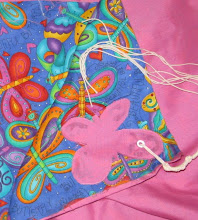
  • The butterflies are in memory of a very special little girl Shoshana Tikvah Cohen z'l who passed away at 3 years old. She loved butterflies and she loved pink. The irony is that Shoshana was being raised in a modern Orthodox family and ultimately wouldn't be a talit-wearer herself. But her Ima gets me ... and gets this talit.
  • I tied three of the four tzitzit corners in Southern California. The fourth I tied in Jerusalem.
  • My original talit bag was actually a pillow cover (the zipable throw-pillow kind) that I bought in Daliyat el Carmel - a Druze Village with amazing textiles. I lost that case and hope to get myself another one on a future trip to Israel. The pattern in the case matched a wall-hanging that one of my best friends has hanging in his kitchen (we bought them at the same place at the same time while staffing a birthright israel trip).

Other facts about my talit:
  • The directions I use for tying tzitzit (and teaching others to do so) come from a Torah Aura Instant Lesson.
  • I used fabric glue to put it all together.
  • My cat Allie has chewed two of the strings, I guess I need to fix that at some point.
  • I almost got beat up in a Jerusalem hotel but a group of young haredim who didn't approve of a woman with a talit. Thank goodness for hotel security and a good friend!
  • If I am ever without my talit, I won't wear another one.